
Where Do Plants Get Energy to Live and Grow? Complete Beginner’s Guide
Table of Contents
summary
- Plants get their energy primarily from sunlight through the process of photosynthesis.
- During photosynthesis, plants combine sunlight, water, and carbon dioxide to produce glucose, their source of food and energy.
- Chlorophyll in green leaves captures sunlight and converts it into usable energy.
- Sunlight is essential for healthy leaf growth, root development, flowering, and overall plant health.
- Indoor plants also require water, nutrients, proper temperature, humidity, and airflow for optimal growth.
- Low light reduces energy production, causing slow growth, pale leaves, and weak stems.
- Many tropical houseplants thrive in bright, indirect light rather than direct sunlight.
- Plants use stored energy at night to continue growing and repairing themselves.
- LED grow lights can effectively supplement natural light in darker indoor spaces.
- Understanding how plants create and use energy helps beginners provide better care and maintain healthier indoor plants.
If you’ve ever kept a houseplant alive longer than a few months, you’ve probably noticed something interesting. Some plants seem to thrive with very little effort, while others suddenly droop, stop growing, or lose color even when you’re watering them regularly.
Most beginners assume water is the main reason plants survive. Water matters, of course, but it’s only part of the story.
The real magic happens when plants create their own energy.
That’s the reason your pothos keeps pushing out new leaves near a sunny window. It’s why outdoor gardens explode with growth during long summer days in Austin. And it’s also why a plant tucked into a dark apartment corner slowly struggles, even if the soil stays moist.
So, where do plants get energy to live and grow?
The short answer is sunlight. But the full process is a lot more fascinating — and surprisingly easy to understand once you break it down in plain English.
Plants get energy primarily from sunlight through a natural process called photosynthesis.
During photosynthesis, plants absorb sunlight through their leaves, take in water through their roots, and pull carbon dioxide from the air. They combine all three to create glucose, which acts as their food and fuel source.
That energy supports everything a plant does, including:
- Growing new leaves
- Developing roots
- Producing flowers
- Repairing damage
- Staying healthy during stress
- Surviving seasonal changes
Without enough light energy, plants can’t produce the food they need to survive.
That’s why lighting is usually the first thing experienced plant owners check when a plant starts declining indoors.
Need Help Choosing the Right Indoor Climbing Plant?
How Plants Get Energy From Sunlight
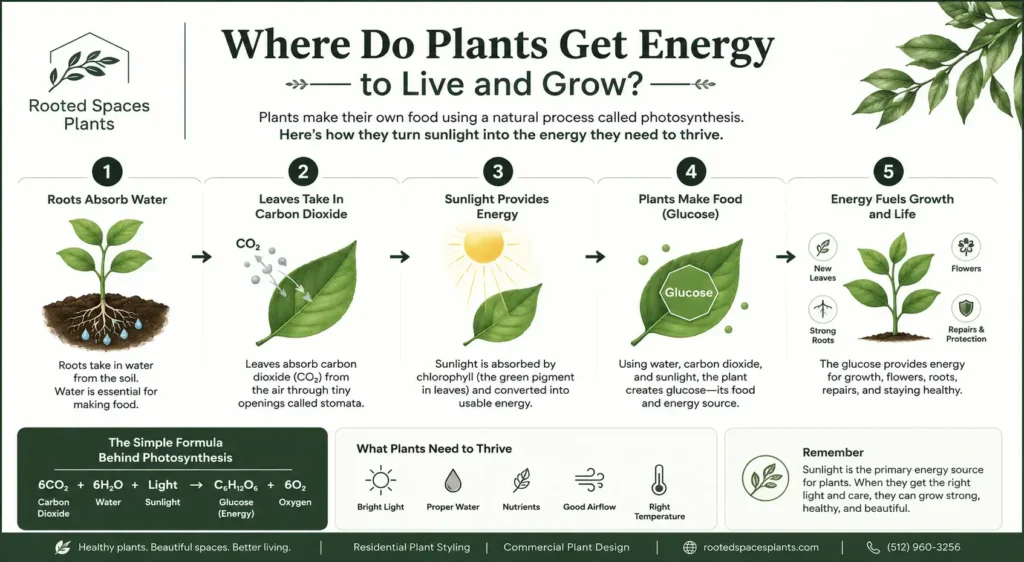
Think of a plant leaf like a tiny solar panel.
Inside every healthy green leaf is chlorophyll, the pigment responsible for that rich green color. Chlorophyll captures sunlight and converts it into usable energy for the plant.
This process happens constantly during daylight hours.
Here’s the simple version of how plants get energy:
- Roots absorb water from the soil
- Leaves take in carbon dioxide from the air
- Sunlight hits the leaves
- The plant converts those ingredients into sugar (glucose)
- The sugar becomes energy for growth and survival
That’s essentially how plants make food for themselves.
Unlike humans or animals, plants don’t eat external food sources. They produce their own.
And honestly, once you understand this, indoor plant care starts making much more sense.
Photosynthesis Explained in Beginner-Friendly Terms
The word “photosynthesis” sounds complicated at first, especially for kids or first-time gardeners, but the idea behind it is pretty straightforward.
Photosynthesis is simply the way plants turn light into energy.
Here’s the scientific formula:
6CO2+6H2O+light→C6H12O6+6O26CO_2 + 6H_2O + light \rightarrow C_6H_{12}O_6 + 6O_26CO2+6H2O+light→C6H12O6+6O2
You do not need to memorize that equation to care for plants successfully. What matters is understanding what it means in real life.
Plants use:
- Carbon dioxide from the air
- Water from the soil
- Light from the sun
to create glucose, which feeds the plant, and oxygen, which is released back into the air.
That oxygen exchange is one reason indoor plants feel refreshing inside homes and offices.
In many homes around Cedar Park and Austin, people notice rooms with healthy greenery simply feel calmer and fresher. There’s real science behind that feeling.
Why Sunlight Matters So Much for Plant Growth
One of the biggest mistakes beginners make is underestimating light.
People often place plants wherever they “look nice” instead of where lighting conditions actually support growth.
A snake plant may tolerate low light for months, but that doesn’t mean it prefers it. Most indoor plants grow stronger, fuller, and healthier when they receive appropriate light levels.
Without enough sunlight:
- Growth slows down
- Leaves become smaller
- Stems stretch toward windows
- Colors fade
- Soil stays wet too long
- Root problems become more common
You’ll especially notice this during winter months or in apartments with limited natural light.
In Texas homes, south-facing windows usually provide the strongest indoor light throughout the day. East-facing windows tend to work beautifully for beginner-friendly plants because the morning sun is gentler.
What Plants Need to Grow Beyond Sunlight
Even though sunlight is the primary energy source for plants, it’s not the only thing they need.
Healthy growth depends on several factors working together.
Water
Water helps transport nutrients through the plant and supports photosynthesis.
Too little water causes dehydration. Too much water suffocates roots.
That balance is where many beginners struggle.
A good rule? Check the soil before watering instead of following a rigid schedule.
Temperature
Most common houseplants prefer temperatures similar to what humans enjoy indoors.
If you’re comfortable in the room, your plants probably are too.
Sudden temperature swings near AC vents, heaters, or drafty windows can stress plants surprisingly fast.
Nutrients
Plants also need nutrients from the soil, especially:
- Nitrogen
- Phosphorus
- Potassium
These nutrients help support leaf growth, root development, and overall plant health.
Overfertilizing, though, is common among enthusiastic beginners. More fertilizer does not equal faster growth.
Sometimes less really is more.
Air Circulation and Humidity
Plants breathe too.
Stale air, extremely dry indoor conditions, or crowded plant placement can slow growth over time.
This becomes especially noticeable in air-conditioned homes around Austin during hotter months when indoor humidity drops.
Even simple changes like opening blinds earlier or rotating plants weekly can make a visible difference.
If you’re styling plants inside a home or workspace and want help choosing varieties that actually fit your lighting conditions, the team at Rooted Spaces Plants offers thoughtful indoor greenery solutions designed for real living spaces — not just Pinterest-perfect corners.
For businesses looking to improve indoor environments with professionally selected greenery, their commercial plant design services are worth exploring.
How Indoor Plants Survive in Lower Light
This is something beginners ask constantly.
“How do plants survive indoors if they naturally grow outside?”
Some plants adapt better to indoor life because they evolved in shaded forest environments where direct sunlight was already limited.
Plants like pothos, ZZ plants, philodendrons, and peace lilies naturally grow beneath larger trees in tropical regions. They’re used to filtered light rather than harsh all-day sun.
That said, “low light” doesn’t mean “no light.”
A dark hallway with zero natural sunlight is difficult for almost any plant long-term unless you add grow lights.
You can usually tell a plant isn’t getting enough energy when it starts showing subtle changes like:
- Leaning heavily toward the windows
- Producing pale or stretched leaves
- Losing variegation
- Dropping older foliage
- Staying damp for unusually long periods
One thing I often tell new plant owners is this: plants communicate slowly. They rarely collapse overnight. Most of the time, they’re giving small warning signs for weeks before bigger issues appear.
Learning to notice those signs is part of becoming a confident plant parent.
How Plants Use the Energy They Create
Once plants make glucose through photosynthesis, they use that stored energy for almost everything happening inside the plant.
That includes:
Growing New Leaves
Every new leaf requires energy to develop. If your plant suddenly stops producing fresh growth during active growing seasons, lighting is usually the first thing worth evaluating.
Building Strong Roots
Healthy roots don’t just anchor plants in soil. They absorb water and nutrients needed for long-term survival.
Weak lighting often leads to weaker root systems over time.
Producing Flowers and Fruit
Flowering plants need extra energy reserves to bloom successfully.
This is why blooming indoor plants often need brighter light conditions than foliage-only plants.
Repairing Stress or Damage
Plants constantly repair themselves after pruning, repotting, temperature stress, or accidental neglect.
Even recovering from underwatering takes energy.
The Science Behind Plant Growth in Real Homes
Plant biology sounds technical until you see it happening in everyday situations.
For example, let’s say you move a healthy monstera from a bright living room into a dim bedroom corner because it matches the decor better.
At first, nothing changes.
A few weeks later, though, growth slows. Leaves become smaller. The stems stretch longer between leaves. Eventually, the plant starts looking sparse instead of full.
That’s the plant responding to reduced energy production.
It’s trying to survive in less available light.
This happens constantly in apartments and homes where aesthetics accidentally override lighting needs.
Good plant styling is really about balancing both.
A beautiful room feels even better when the plants inside it are genuinely thriving instead of barely hanging on.
For homeowners wanting help designing healthier indoor plant setups that actually work with their natural lighting conditions, residential plant styling services can help create spaces that feel natural, livable, and easier to maintain long-term.
Common Beginner Mistakes That Affect Plant Energy
Most struggling houseplants aren’t dying from lack of care.
They’re usually suffering from mismatched conditions.
Here are some of the most common issues beginners run into:
Watering Too Often
People see slow growth and assume plants need more water.
But if the real issue is insufficient light, extra watering can actually make things worse by stressing the roots.
Ignoring Seasonal Changes
Plants naturally grow more slowly during shorter winter days.
That’s normal.
Many indoor gardeners in Texas notice explosive growth during spring and summer when sunlight intensity increases again.
Choosing Plants for Looks Alone
That dramatic fiddle leaf fig may look stunning online, but it needs strong light to stay healthy.
Matching plants to your environment usually works better than forcing difficult plants into unsuitable spaces.
Forgetting to Rotate Plants
Plants lean toward light sources over time.
Rotating pots every week or two helps encourage more balanced growth.
Can Artificial Light Replace Sunlight?
Yes — to a point.
Grow lights can absolutely help indoor plants survive and even thrive, especially in darker apartments or rooms with limited windows.
Modern LED grow lights have improved dramatically over the past few years. Many are subtle enough to blend into home decor without making your living room feel like a greenhouse.
Still, natural sunlight remains the ideal energy source for most plants whenever possible.
If you’re using grow lights, consistency matters more than intensity alone. Plants usually respond better to steady daily exposure than random bursts of bright light.
Why Understanding Plant Energy Changes Everything
Once you understand where plants get energy from, plant care becomes less confusing.
You stop guessing.
Instead of treating yellow leaves, slow growth, or drooping as random problems, you begin tracing them back to environmental causes.
Usually, the answer connects to one of these:
- Light
- Water
- Airflow
- Soil health
- Temperature
And more often than not, light is the biggest piece of the puzzle.
That’s why experienced plant owners pay so much attention to windows, room direction, seasonal sun patterns, and placement inside the home.
Healthy plants aren’t just “lucky.”
They’re getting the conditions they need to create enough energy to support life and growth.
Conclusion
So, where do plants get energy to live and grow?
They get it primarily from sunlight through photosynthesis — a natural process that allows them to turn light, water, and carbon dioxide into usable fuel.
That energy powers every part of a plant’s life, from root development to new leaves and flowers.
For beginners, understanding this simple concept can completely change the way you care for indoor plants.
Instead of focusing only on watering schedules, you start thinking about the bigger picture: light quality, placement, airflow, and overall growing conditions.
And honestly, that’s usually the turning point where plant care becomes far less frustrating and a lot more rewarding.

Sanaz Haghshenas
Founder & Plant Specialist at Rooted Spaces
With years of hands-on experience working with live plants and interior spaces, Sanaz helps homeowners and businesses create environments that feel more welcoming, balanced, and connected to nature. Her approach combines practical plant expertise with thoughtful design to bring lasting greenery into modern homes and workspaces.
FAQs
Plants get energy from sunlight through photosynthesis. They combine sunlight, water, and carbon dioxide to create glucose, which acts as food for growth and survival.
Plants store energy created during daylight hours and continue using that stored energy at night for growth and maintenance.
Most plants cannot survive long-term without light. Some low-light plants tolerate dim conditions temporarily, but all plants need some form of light energy eventually.
Photosynthesis is the process plants use to turn sunlight, water, and air into food and energy.
Not always. Many indoor plants prefer bright indirect light instead of harsh direct sun, especially tropical houseplants.
Slow growth often happens because of insufficient light, poor soil conditions, overwatering, low humidity, or seasonal changes.
Yes. Quality LED grow lights can support healthy indoor plant growth, especially in spaces with limited natural sunlight.